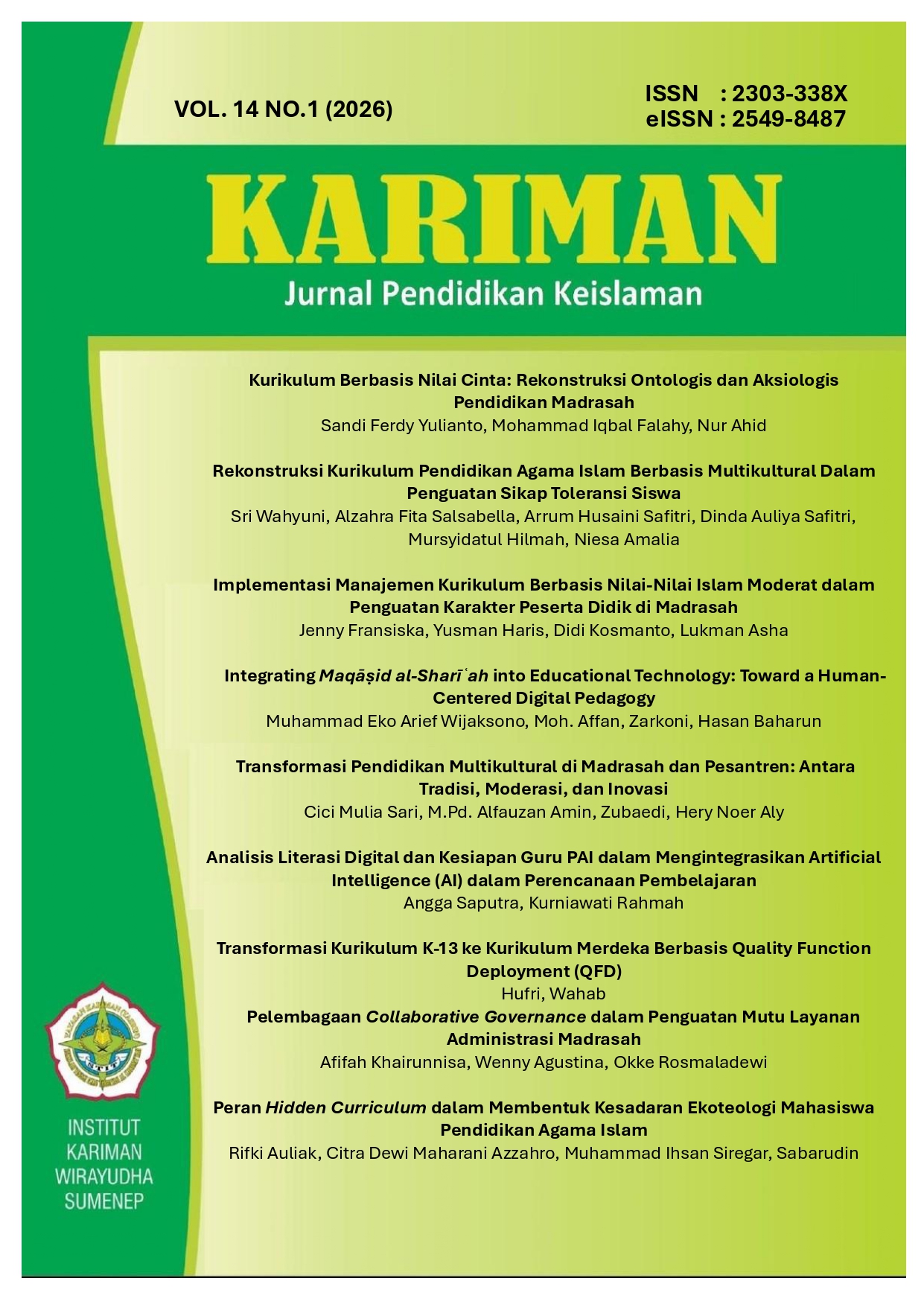
Peran Hidden Curriculum dalam Membentuk Kesadaran Ekoteologi Mahasiswa Pendidikan Agama Islam
DOI:
https://doi.org/10.52185/kariman.v14i1.1154Keywords:
hidden curriculum, Islamic ecotheology, Pendidikan Agama IslamAbstract
Ecotheological awareness in Islamic education is formed not only through the formal curriculum but also through the hidden curriculum present in the culture and practices of campus life. This study used a qualitative approach with a transcendental phenomenological design. Data were obtained through in-depth interviews, participant observation, and documentation studies, then analyzed using Clark Moustakas' transcendental phenomenological model. The findings indicate that ecotheological awareness of Islamic Education (PAI) students at INSIMA Majenang is formed through campus religious culture, lecturers' role models, hygiene habits, and daily social experiences. Contradictory experiences that do not reflect ecological values actually encourage critical reflection, leading to a more reflective and transformative understanding of ecotheological awareness. This awareness is actualized in ecological behaviors such as maintaining environmental cleanliness, reducing the use of single-use plastics, maintaining campus facilities, and increasing environmental awareness. The hidden curriculum plays a significant role in the formation of students' ecotheological awareness. This study resulted in the concept of the Reflective Ecotheological Internalization Model and Spatial Exam Pedagogy, which explains that both positive and contradictory experiences can be a means of forming ecological awareness based on Islamic values.
References
Adawiyah, Rabiyatul, Sulaiman Jazuli, and Noor Fitriah. “Dari Pembiasaan Ke Internalisasi : Peran Hidden Curriculum Dalam Penguatan Karakter Religius” 6, no. 2 (2026): 199–209.
Beck, Ulrich. Risk Society: Towards a New Modernity. London: Sage Publications, 1992.
Bria, Makarius Erwin, Kokom Komalasari, Dadang Sundawa, and Asep Mahpudz. “Ecological Citizenship: The Role of Young Citizens in Environmental Responsibility and Sustainability.” ASANKA : Journal of Social Science and Education 6, no. 2 (2025): 289–310. https://jurnal.iainponorogo.ac.id/index.php/asanka/article/view/11637.
Creswell, Jhon W. Research Design: Qualitative, Quantitative, and Mixed Methods Approaches. Thousand Oaks: Sage Publications, Inc, 2018.
Devi, Nur, Yusiawati Gumelar, and Indira Rachmawati. “Internalisasi Nilai Islam Melalui Hidden Curriculum Di Ra Utsman Bin Affan,” 2026, 2210–16.
Festinger, Leon. A Theory of Cognitive Dissonance. Stanford, CA: Stanford University Press, 1957.
Giroux, Henry A. On Critical Pedagogy. London: Bloomsbury Academic, 2020.
Herawati, Sri, and Sofwan Adiputra. “Manajemen Pendidikan Evaluasi Kurikulum Berbasis Lingkungan Pada SMP Adiwiyata Kabupaten Pringsewu” 20, no. 2 (2025): 315–28.
Jackson, Philip W. Life in Classrooms. Teachers College Press, 1990.
Kadi, Titi, Badrut Tamam. “FOSTERING ECOLOGICAL AWARENESS: THE ROLE OF ECOTHEOLOGY-BASED ISLAMIC EDUCATION IN HIGHER EDUCATION Titi Kadi 1 ( ) , Badrut Tamam 2” 09, no. 03 (2025): 347–63.
Malahati, Fildza, and Mohamad Agung Rokhimawan. “The Implementation of Hidden Curriculum On Fifth Grade Students’ Character Development at Islamic Elementary School.” DIDAKTIKA: Jurnal Pendidikan Sekolah Dasar 6, no. 2 (2024): 153–64. https://doi.org/10.21831/didaktika.v6i2.67252.
Maulana Bagus Rahmat, Masruchin, and Fauzan. “The Idea of Islamic Ecotheology in Responding to the Global Environmental Crisis: An Analysis of the Concepts of Khalifah, Mīzān, and Maṣlaḥah.” Indonesian Journal of Islamic Theology and Philosophy 7, no. 1 (2025): 93–110. https://doi.org/10.24042/ijitp.v7i1.27596.
Moleong, Lexy J. Metodologi Penelitian Kualitatif. Bandung: PT Remaja Rosdakarya, 2017.
Moustakas, Clark. Phenomenological Research Methods. Thousand Oaks: SAGE Publications, 1994.
Muhammad Nurhalim, Ahsan Hasbullah. “Jurnal Pendidikan Edutama.” Hidden Curriculum: Conceptual Review and Practice of Its Implementation in the Context of Education 7, no. 1 (2020): 127–42.
Munir, A, and R Fauzan. “Paradigma Pendidikan Islam Transformatif.” Jurnal Pendidikan Dan Pemikiran Islam 23, no. 2 (2023): 371–90.
Nur Fuad, Ai Fatimah, Rafa Basyirah, and Ihsana El Khuluqo. “The Hidden Curriculum in Islamic Education: Developing Critical Thinking and Moderate Attitudes among Students.” Fikroh: Jurnal Pemikiran Dan Pendidikan Islam 17, no. 1 (2024): 51–66. https://doi.org/10.37812/fikroh.v17i1.1401.
Nur Inayah, Nor Faizah, Salmah Fa’atin. “Internalisasi Nilai-Nilai Pendidikan Islam Dalam Membangun Kesadaran Ekologis Siswa Di” 10 (2025): 270–84.
Sapitri, Elfira Yunita, Tasman Hamami, Khaerul Muttakin, Universitas Islam, and Sunan Kalijaga. “Integrating Ecotheology into Islamic Religious Education : A Systematic Literature Review on Students ’ Spiritual , Social , and Cognitive Character Development” 8, no. 2 (2025): 178–201. https://doi.org/10.22373/jie.v8i2.34136.
Septiani, Sisca. “10519-Article Text-31971-1-10-20221223[1].” Jurnal Pendidikan Dan Konseling 4, no. 6 (2022): 12527–33.
Sugiyono. Metode Penelitian Kualitatif. Bandung: Alfabeta, 2023.
Tyas Ayu Farah Dina, Anjani Dzikry Ilahana, Safira Tsaniyatur Rohaimi, Much. Febri, and Widodo Hami Ardiyanto. “Peran Pendidikan Agama Islam Dalam Menghadapi Krisis Ekologi Dan Menumbuhkan Kesadaran Iman Terhadap Alam” 6, no. 1 (2026).
Wasil, Wasil, and Muizudin Muizudin. “Ekoteologi Dalam Menyikapi Krisis Ekologi Di Indonesia Perspektif Seyyed Hossein Nasr.” Refleksi 22, no. 1 (2023). https://doi.org/10.15408/ref.v22i1.31403.
Yvonna S. Lincoln, Egon G. Guba. Naturalistic Inquiry. Beverly Hills: Sage Publications, 1985.
Downloads
Published
How to Cite
License
Copyright (c) 2026 Rifki Auliak, Citra Dewi Maharani Azzahro, Muhammad Ihsan Siregar, Sabarudin

This work is licensed under a Creative Commons Attribution 4.0 International License.