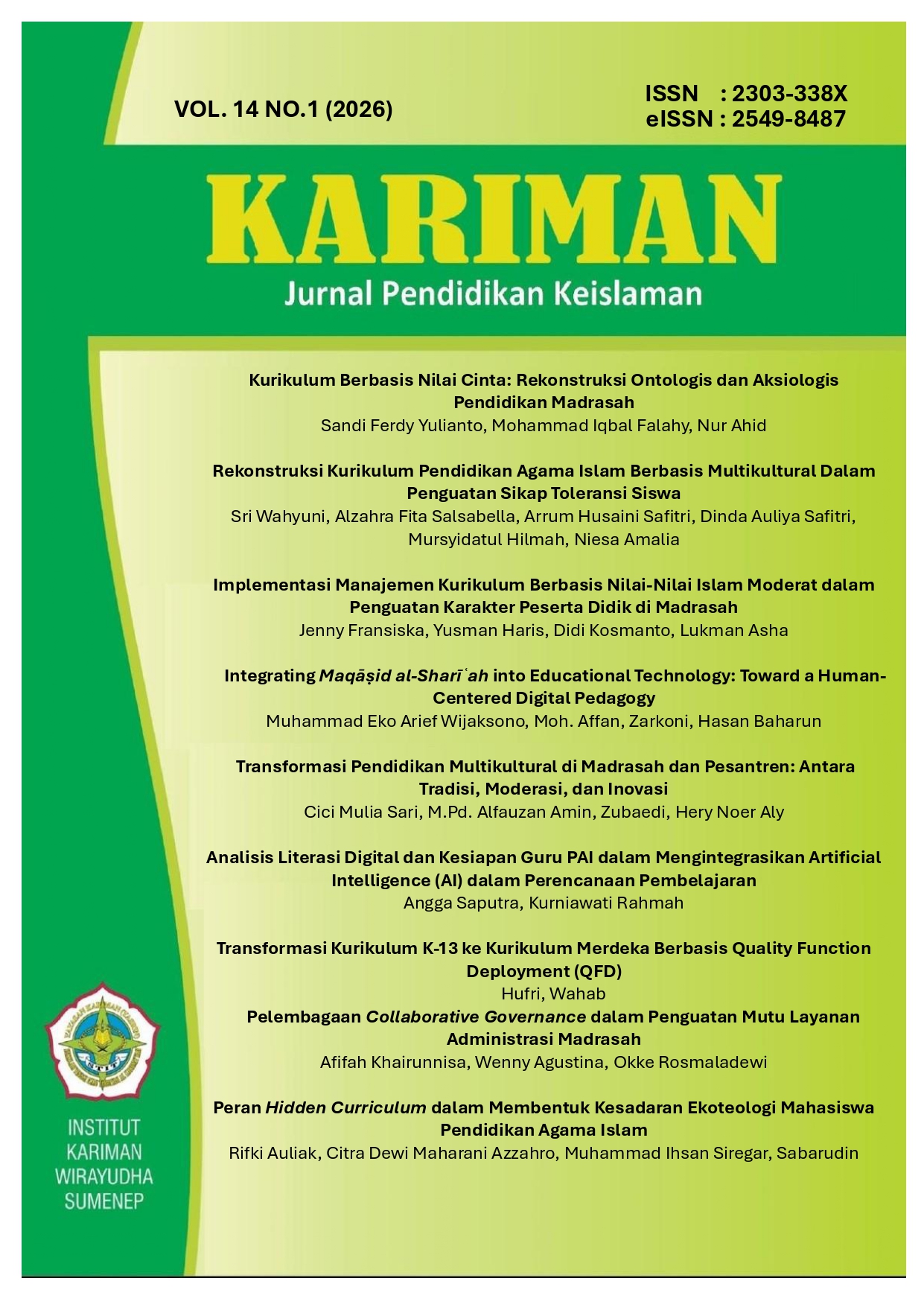
Pelembagaan Collaborative Governance dalam Penguatan Mutu Layanan Administrasi Madrasah
DOI:
https://doi.org/10.52185/kariman.v14i1.1145Keywords:
collaborative governance, educational administration, school governanceAbstract
This study analyzes the institutionalization of collaborative governance in strengthening administrative service quality in a madrasah. Administrative services support school governance, information transparency, academic document management, and public trust. This study used a qualitative case study method at MTs Al Hasan Karawang. Data were collected through in-depth interviews, observation, and documentation involving 11 informants, including the principal, teachers, administrative staff, school committee members, parents, and students. Data were analyzed using the interactive model of Miles, Huberman, and Saldaña through data condensation, data display, and conclusion drawing. The findings show that administrative service improvement has involved various stakeholders through communication, coordination, document management, information sharing, and complaint handling. However, the collaboration remains largely informal and has not been fully supported by integrated digital systems, clear service standards, and regular data-based evaluation. This study concludes that administrative service quality can be strengthened through facilitative leadership, clear stakeholder role division, gradual administrative digitalization, administrative staff capacity building, and data-based service evaluation.
References
Ansell, Chris, and Alison Gash. “Collaborative Governance in Theory and Practice.” Journal of Public Administration Research and Theory 18, no. 4 (2008): 543–571. https://doi.org/10.1093/jopart/mum032.
Bannink, Duco, Alessandro Sancino, and Maddalena Sorrentino. “Governance without We: Wicked Problems and Collaborative Governance.” Public Policy and Administration 39, no. 3 (2024): 301–323. https://doi.org/10.1177/09520767241239863.
Choiriyah, Fitrotul, and Gunarti Dwi Lestari. “Strategies for Digital Transformation in Madrasah Education for Institutional Excellence.” Academia Open 10, no. 1 (2025). https://doi.org/10.21070/acopen.10.2025.10463.
Emerson, Kirk, Tina Nabatchi, and Stephen Balogh. “An Integrative Framework for Collaborative Governance.” Journal of Public Administration Research and Theory 22, no. 1 (2012): 1–29. https://doi.org/10.1093/jopart/mur011.
Firdaus, Fadli, Nadhilah Nur Fajrina, and Mia Syafrina. “Analysis of School Administrative Service Quality Using SERVQUAL Model in SMA Negeri 19 Batam.” Jurnal Bisnis Mahasiswa 5, no. 3 (2025): 1261–1269. https://doi.org/10.60036/jbm.618.
Haddade, Hasyim, Ahmad Nur, Andi Achruh, Muhammad Rasyid, and Muhammad Ibrahim. “Madrasah Management Strategies through Madrasah Reform Program: An Evidence from Indonesia.” International Journal of Educational Management 38, no. 5 (2024): 1289–1304. https://doi.org/10.1108/IJEM-05-2023-0236.
Håkansson, Jan, and Carl-Henrik Adolfsson. “Local Education Authority’s Quality Management within a Coupled School System: Strategies, Actions, and Tensions.” Journal of Educational Change 23, no. 3 (2022): 291–314. https://doi.org/10.1007/s10833-021-09414-6.
Hasbiyallah, M. R. Alfauzy, A. F. Hakim, M. S. Alfaruq, and A. Sumarni. “Participatory Leadership in Madrasah Governance: Exploring Practices, Paradoxes, and Power Relations in Islamic Secondary Education.” JUMPA: Jurnal Manajemen Pendidikan 6, no. 2 (2025): 233–244. https://doi.org/10.33650/jumpa.v6i2.14809.
Khurniawan, Arie Wibowo, Iim Sailah, Pudji Muljono, Bambang Indriyanto, and M. Syamsul Maarif. “The Collaborative Strategy of Total Quality Management and School Governance to Improving Effectiveness of Vocational School-Based Enterprise.” Journal of Educational and Social Research 11, no. 2 (2021): 10–21. https://doi.org/10.36941/jesr-2021-0026.
Miles, Matthew B., A. Michael Huberman, and Johnny Saldaña. Qualitative Data Analysis: A Methods Sourcebook. 4th ed. Thousand Oaks, CA: SAGE Publications, 2020.
Norman, E., F. Aizat, H. Feviasari, and M. Nuryani. “Strategic Leadership of School Principals in Enhancing Educational Quality Through Transformational Management and Collaborative Governance.” El-Idare: Journal of Islamic Education Management 11, no. 1 (2025): 81–88. https://doi.org/10.19109/elidare.v11i1.27335.
Parasuraman, A., Valarie A. Zeithaml, and Leonard L. Berry. “SERVQUAL: A Multiple-Item Scale for Measuring Consumer Perceptions of Service Quality.” Journal of Retailing 64, no. 1 (1988): 12–40.
Republik Indonesia. Peraturan Pemerintah Nomor 57 Tahun 2021 tentang Standar Nasional Pendidikan. Jakarta: Pemerintah Republik Indonesia, 2021. https://peraturan.bpk.go.id/Details/165024/pp-no-57-tahun-2021.
Republik Indonesia. Peraturan Pemerintah Nomor 4 Tahun 2022 tentang Perubahan atas Peraturan Pemerintah Nomor 57 Tahun 2021 tentang Standar Nasional Pendidikan. Jakarta: Pemerintah Republik Indonesia, 2022. https://jdih.bpkp.go.id/pencarian/1577/detail.
Stahl, Norman A., and James R. King. “Understanding and Using Trustworthiness in Qualitative Research.” Journal of Developmental Education 44, no. 1 (2020): 26–28. https://files.eric.ed.gov/fulltext/EJ1320570.pdf.
Yidana, Peter, Emmanuel A. Bangase, Moses R. Bagina, and Gabriel Billa. “A Model of Administrative Service Quality in Higher Education.” British Journal of Education, Learning and Development Psychology 6, no. 3 (2023): 52–75. https://doi.org/10.52589/BJELDP-XX8LIQLC.
Yin, Robert K. Case Study Research and Applications: Design and Methods. 6th ed. Thousand Oaks, CA: SAGE Publications, 2018.
Downloads
Published
How to Cite
License
Copyright (c) 2026 Afifah Khairunnisa, Wenny Agustina, Okke Rosmaladewi

This work is licensed under a Creative Commons Attribution 4.0 International License.